

Day 6/30 of inkhaven.
If one considers the how to decompose voice, people typically start by considering pitch, as it’s both the easiest to measure and the one people talk about the most.
However, while raw pitch does matter, it’s not quite how humans intuitively distinguish between voices of males and females, so it’s really not what you should start off by optimizing.
There is far too much content on voice training and aspects of passing voice. I won’t provide training instructions directly, but will describe the main aspects of voice that matter and provide links to a list of guides.
Here are a few of the main factors of voice that matter, and I will move on to how to resources for changing them in a later post.
Though it’s worth noting that the language used to describe different aspects of voice other than pitch is extremely inconsistent. But with that said, the main 5 aspects of voice are: Resonance, Weight, Pitch, Speech Pattern, Consistency.
Resonance is the size/filter of the voice.
Weight is the “density” of the sound source.
Pitch is how high or low the voice is.
Speech patterns are how you change your voice in words and sentences.
Normalization is making sure you are using your voice consistently.
I will now describe them in more detail. You may find it useful to learn how to read spectrograms. You probably also want to know that the Larynx is the voice box, which is seen as an Adam’s apple.

Resonance
known as: vocal tract size, vocal size, formants, brightness/darkness, small voice/large voice. Controlled not by vocal chords directly but by the space in your mouth.
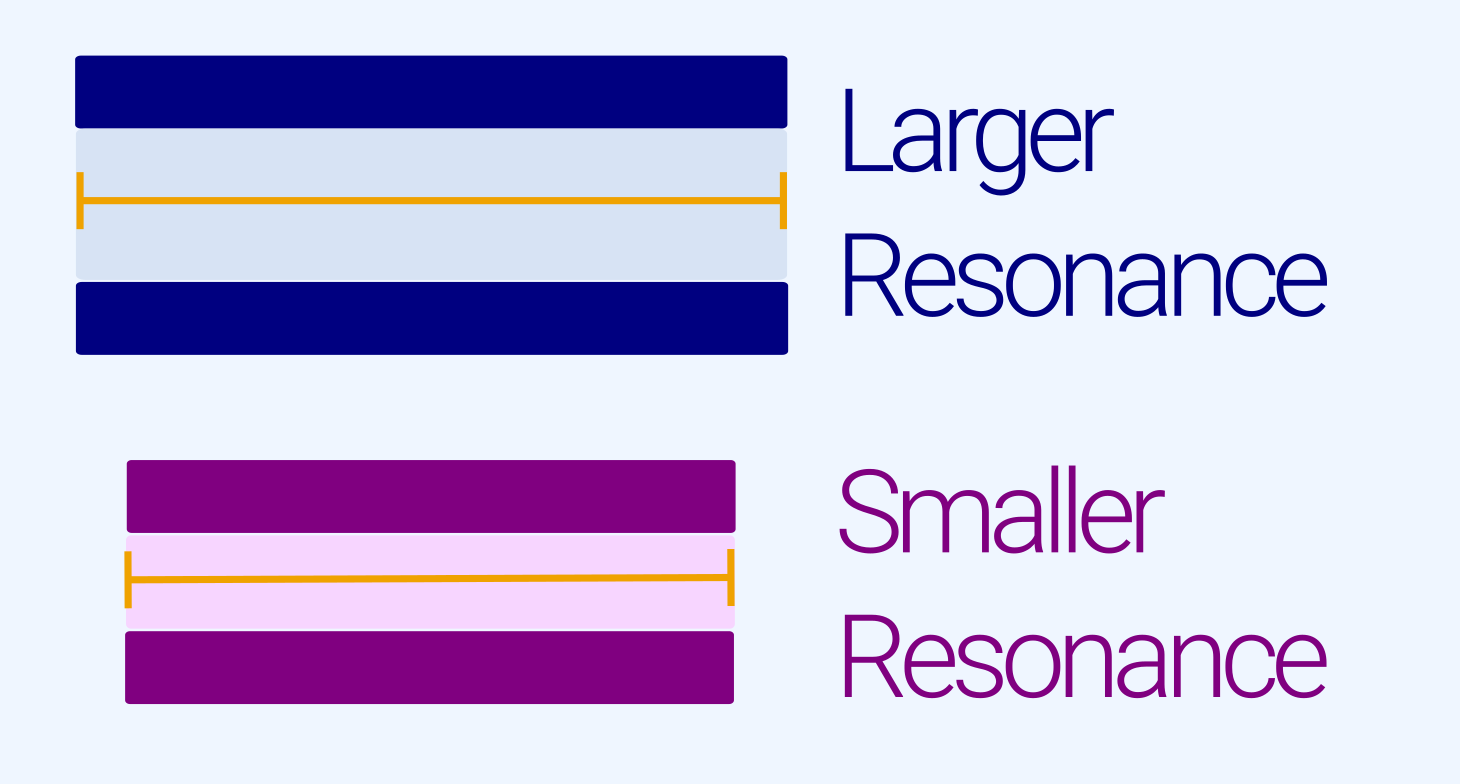
The most important aspect of voice for passing is “resonance”. This posits that voices can get smaller/brighter or larger/darker This is mostly affected by how much space there is between your larynx/voice box, and your lips. The best descriptive explainer I think is this one: https://scinguistics.com/encyclopedia/vocal-tract-length/
One naturally has some intuitions about this when listening to the echos of a sound in a container with various amounts of liquid in it. Importantly, the main pitch can also change somewhat, but that is not the primary effect.
On a physical level, there is the main frequency F0 which is the vibration of the vocal chords, and is the main source of sound which describes pitch. But between your vocal chords and leaving your mouth, there is your vocal tract.
The other aspects in the mouth and throat that have their own weaker forms of vibration and enhance or reduce different frequencies, which are primarily modifiable by changing the size of the vocal passage. Most obviously this is done by raising the larynx, but there are subtler things one can do too.
In practice, many find it easier to try to listen to examples of resonance and rather than to see it described on a page. One video you can watch is this one by TransVoiceLessons.
Weight
known as: voice quality, source quality, phonation, glottal weight, vocal fold mass, heaviness/lightness, thickness/density, buzziness. Controlled by voice box directly.
Once you learn to control resonance by modifying your vocal tract, the next main aspect is called “weight”. This one is harder to describe than resonance, but is sometimes heard as being more buzzy/heavy/thick vs more soft/light/airy. This involves your voice box directly.
The main thing is trying to understand the pattern of how your vocal chords vibrate.
One aspect of this is vocal fold thickness. Having gone through puberty, your vocal cords get larger and thicker, and have more mass.
The second aspect is how firmly the folds come together (aka: Adduction vs Abduction). Coming together more tense and closely means a voice is buzzier and heavier, as they become harder to vibrate. Coming apart slightly means the voice is more breathy and airy.
The third part is Loudness. A louder sounds requires more subglottal pressure, and requires greater air pressure, and also increases buzziness and heaviness. A softer sound means makes it easier to reduce excess closure.
I will would like to describe and understand it better physically, but a good intuitive video on how it affects voice is in this video by Renée Yoxon.
Pitch
known as: F0, fundamental frequency, speaking pitch, speaking fundamental frequency, pitch floor, pitch range
Everybody knows pitch. I won’t explain it too much. Higher pitch = faster vibrations, lower pitch = slower vibrations. Women have higher pitch (~93–135 Hz for males vs ~162–238 Hz for females). It’s important but should be learned only after you have learned how to control the previous two.
Speech patterns / prosody
known as: prosody, intonation, speech style, phrasing, articulation, pragmatics, communication style.
There are other differences in speaking between men and women. Men tend to have a more monotone voice, while women tend to vary their pitch more. Other things that change are emphasis in a sentence, how long vowels and how sharply consonants are said, etc.
This should be done after being able to land in the correct resonance and weight.
Normalization
known as: knocarryover, habituation, automaticity, generalization, integration, stabilization, default voice, maintenance.
A final aspect that is important, is to be able to hold a voice consistently. Many people can do a passing voice, but end up slipping up some words or sounds and lose consistency that way, in a way that gets clocked. The main way to avoid this is to practice lots (achievable for most), or to get surgery otherwise. (It maybe be possible to get botox on the vocal chords to unlearn some speech patterns too)
Overall, there are some aspects of voice that can be split up relatively cleanly if one tries