

Written as part of Inkhaven (day 4/30). Erring towards getting a post out every day, rather than making sure every detail is double checked.
Preamble
I don’t think this is a good way of life. It is not that difficult to train yourself into noticing all of these traits, but much harder to train yourself out of it. It is possible to unlearn, but it will never be the same.
If you are mostly happy, and don’t mind how you look, and enjoy your relationship with others, I’d probably recommend against learning to look out for the various aspects that differ between you and others, and between other people too. It feels strictly worse. You have been warned.
But if you have gotten as far as finding this page, you are probably pretty deep, so I guess I will describe what it’s like.
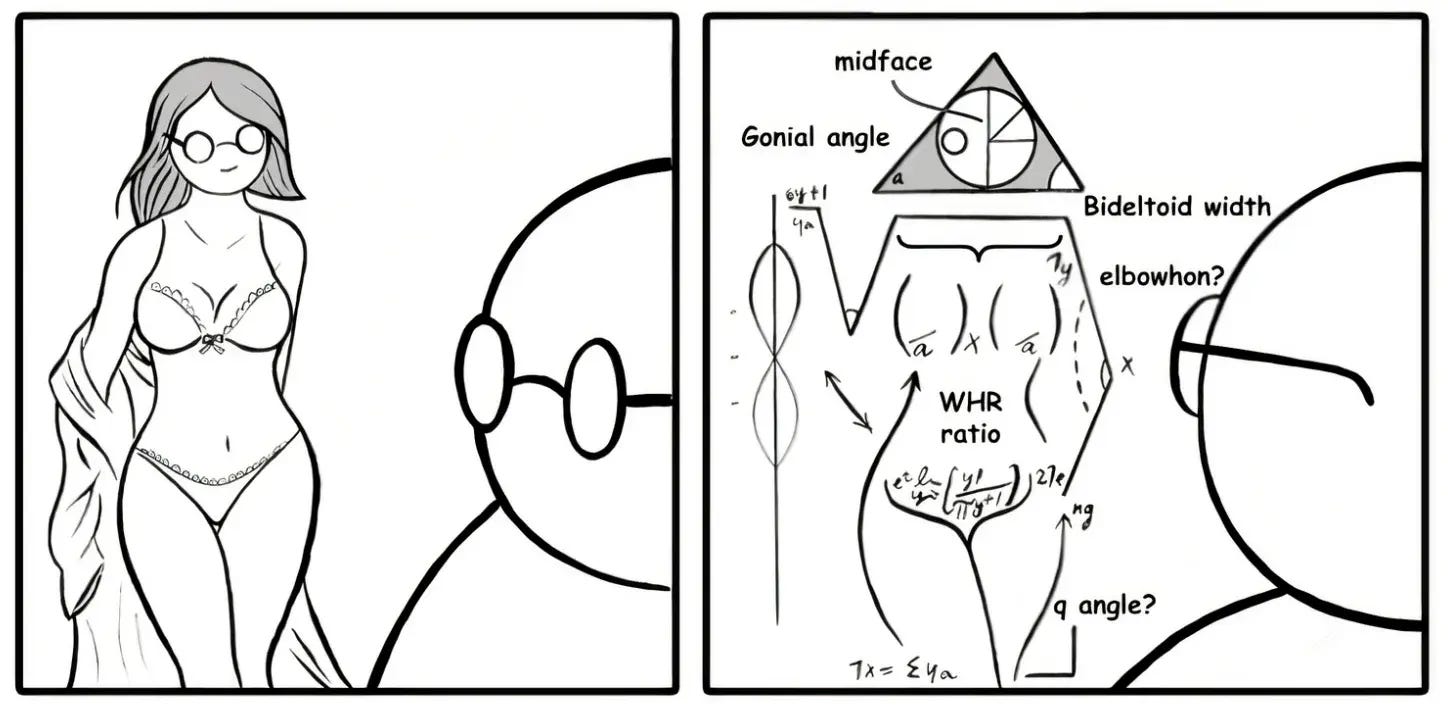
As a starting point, I think it helps to consider two common types of error people make when judging themselves.
Two types of Errors
The memes in trans online spaces often have two memes of how early-stage trans people view themselves, which fall into two categories of error:
False Positive: those who think they pass really well, but in actual fact don’t pass
False Negative: those that do pass really well, but don’t think they pass at all
I don’t think this is quite true. But it has some predictive power. Both are errors in self-perception, but have different consequences.
This is also not quite a “binary”. One can often have both [false positive] and [false negative] flags on different aspects of their appearance, and perhaps these combine to give a roughly accurate image.
Type 1 Errors - False Positive
The first often leads people to live their lives as if they pass. Wear whatever clothes they want, socialize as if they are the gender they want to be, live their best life. As a cost, there is perhaps some societal judgement, though this depends in some part to where one lives. It is true that many parts of the world can be harsh, but with some confidence and brazenness, it often doesn’t matter in the end.
This often happens when one notices some few subset of the traits that might matter (the good ones), but misses the rest of the traits, and doesn’t combine this into a complete view in how these factors add up.
For the most part, if one lives a life as they wish with directionally false-positive views, this can be a pretty happy life.
One can also be pretty knowledgeable about their shortcomings, but live their life this way anyway. While this may seem cringe, i find it quite admirable.
Type 2 Errors - False Negatives
Type two errors are an error in self-perception too. This often leads one to stay indoors, avoid people, continue to dress as their gender assigned at birth. Often this is coupled with some form of social anxiety and belief that people are judging them harshly, sometimes more harshly than other people really think.
Perhaps related is some discussion on social anxiety, and trying too hard to control how other people who don’t matter respond to you.
There are many very transphobic individuals out there, but for the most part, few have put the effort to understand how all the traits add up to show one’s appearance. And for many (but not all people), it is still sometimes achievable to [use time and effort] and [change how you appear] and thus [alter people’s appearance of you such that you look like a “kinda androgynous” person of the gender you wish to appear as.
But really, the same error is happening in these people too. One notices some few subset of the traits that might matter (the bad ones), and doesn’t combine this into a complete view in how these factors add up.
I think to some extent, i think for people with a similar neurotype to me, who have type-2 errors too, the only way out is through. To learn how to compare all the traits. to look at all various people and try to seriously control your mind:
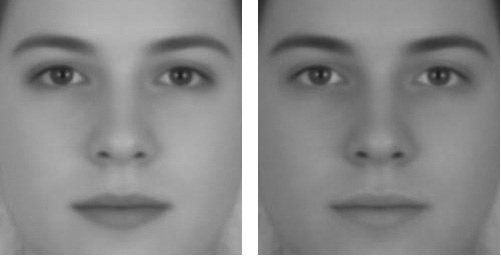
“Could i see this person as a guy if i try really hard? Could i see this same person as a girl if i try really hard? What are the actual key things that makes the difference?”
One approximate loop is:
find a trait of yours that you kinda know pretty well (most of them)
try to look at loads and loads of men and women in the wild. see how it compares.
What does the distribution look like?
Are there any men who have that feature the same as you? Are there any women who have that same feature as you?
I made a list of some of the most important traits previously.
Generally, for basically all traits [other than a few, eg, facial hair, extreme chest projection] there is usually some examples in both genders that have it in the wild. It might take a few weeks rather than a few hours, and it is much better to look at a non-homogeneous population.
I personally found that I used to be very insecure about my jawline, but after seeing more and more examples of people, I guess I am not only a bit insecure about it. My guess for other people, is that this could be true for things like height, browbone, nose, shoulders, etc.
I also found, just going into various trans social groups, you can often find a pattern, where there will be 4 trans girls, and each one of them will think that the other 3 people pass but that they, themselves, do not pass.
But again, passing is not a strict binary. Some few people will be able to discern almost anyone. Most trans people can usually kinda tell when someone is trans but not always. Most people are much worse at reading these signals, and many are not paying nearly as much attention as you are.
And to be honest, the thing that makes someone go from [some suspicion] to [probably trans] is voice.
I won’t pretend that traits that are rarely-but-not-never found in cis people are not informative at all, nor that people don’t see your traits that don’t pass. But for many, it’s not as bad as you think.
Many family members or people who have known you for a long time, will remain blind to changes in how you look, to an almost comical level. For most, as you go around life, more people will start seeing you as the opposite gender, while your old friend groups will continue to see you by how you used to look before.
I think this points towards that people really do have pretty strong priors one way or another, and that once that impression is set, they don’t typically change it unless it’s particularly jarring.
And many people have far less ability to discern than you might think.
If I were to rank how well people are able to compare traits, i would say something like: cis men < cis women << trans people. There are exceptions to this of course.
Overall, you can just learn to perceive yourself accurately in relation to other people. As time goes on, and you spend more time on a good dose of HRT, and changing your clothes, and altering your hair and your facial hair, many people get to a pretty good position in terms of visuals. What is typically left is then changing your voice, which is difficult, but is often doable.
I will discuss these a bit more in the next days