

Day 19/30 of writing everything I know down daily
Yesterday I wrote about short-term hair removal techniques.
Today I move on to medium-term hair reduction techniques. I mostly talk about laser here, but briefly talk about home IPL and Eflornithine.
As discussed yesterday, you may want to also make sure your DHT levels are low too, to prevent new follicle formation and somewhat reduce intensity of growth. This can be done with an 5-alpha reductase inhibitor such as finasteride or dutasteride (as mentioned in preventing hair-loss article), but spironolactone and cyproterone acetate or a GnRH-agonist can help too.
Note that for the most part, many of these only work if the hair is currently growing in the hair follicles, so doing laser after waxing is a no-go. You want to wait like 4 weeks until the hairs grow back. You also want to avoid too much UV exposure and retinoids on the areas too.
And none of these are truly permanent, they only reduce hair growth. I will talk about permanent hair-removal tomorrow (ie: electrolysis)
Laser Hair Removal
One of the most common and well-known hair reduction techniques is via laser hair removal.
How long does it take?
Typical starter pack is to do ~8 sessions spaced apart by 4 weeks (though for many it takes much longer, 12-20 sessions, or spaced apart more, 6-8 weeks) followed by lower frequency “top up sessions” afterwards.
Only actively growing follicles are affected by laser, and you have many hairs each in different phases of growth. Thus it typically takes many sessions to get all the hairs while they are in the growing phase.
If you want to get the most hair removed in the fewest number of sessions, then you typically want to wait around 4 weeks between sessions on face, and longer on other parts of the body.
If you have more money than time, you are also able to do it more often than this, but there are diminishing returns.
Some Considerations on Hair and Skin Color
It is possible to do procedures that remove hair more. The main contender for this is laser. Before going into detail about it though, it’s worth knowing vaguely how it’s supposed to work.
The main idea is to shining very high intensity light in short bursts, which should hopefully get absorbed mostly by your hair, but not interact much with your skin. Ideally for this, you would want to have a combination of:
very dark hair
very light skin
deviation from this does not necessarily mean that it wouldn’t work, but the further away from this ideal you are, the less well it would work.
Hair color types
If you have black or dark brown hair, laser is usually viable.
If you have a middling ligher brown hair, or red hair, then it’s more iffy, but it can still sometimes work and be helpful.
If you have grey or blonde hair, then hair removal is unlikely to work at all, and there is higher chance of potential risks.
It’s worth noting that people’s body hair and facial hair can often differ in color, so you should be judging based on the color of the hair you want to remove, but typically these are quite correlated.
Skin color types
There are rough categories for skin types, labelled on the fitzpatrick scale.
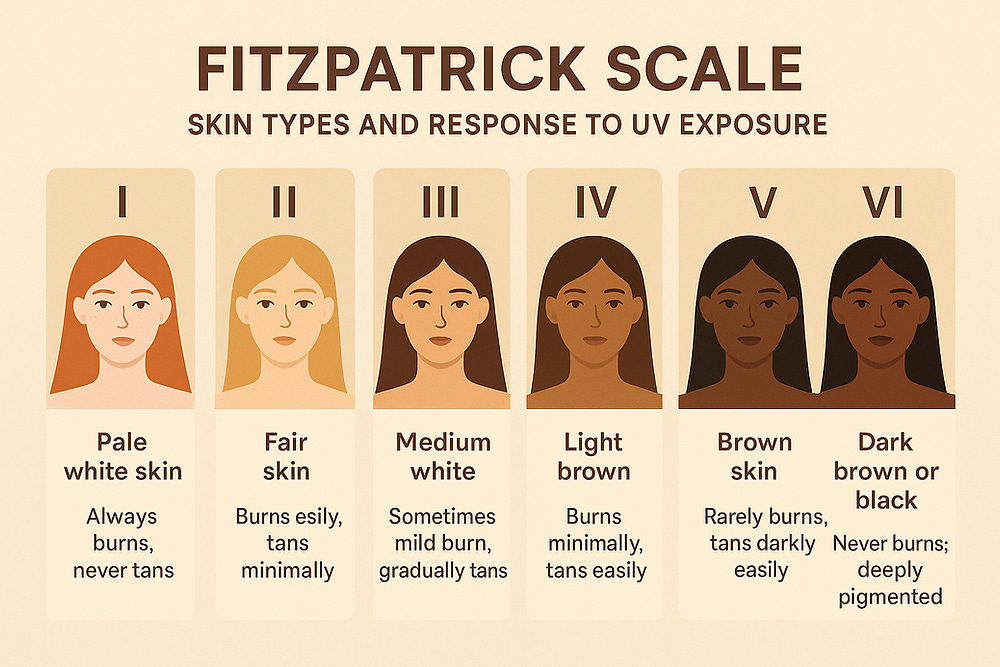
I will roughly categorise these as:
Fitz I-III light skin
Fitz IV medium skin
Fitz V-VI dark skin
The lighter the skin you have, the easier a time it will be to get laser hair removal, though there do exist different laser types that can help.
Laser Hair Removal Types
The balance with light sources is that you want it to be as absorbed as possible by the hair melanin, but as non-interacting as possible with skin melanin. There are a few different methods but it’s kind of variable.
There are a three main laser types used these days:
Alexandrite 755 (most absorbed by melanin, but for lighter skin only)
Diode 810 (intermediate)
Nd:YAG 1064 nm (least aborbed by skin but also less absorbed by thin/light hair)
it is also common to get non-laser high intensity pulsated lights (IPL 500-1200 nm).
Clinical IPL is supposedly not quite as good as 755nm for light-skinned people, but is inexpensive and can sometimes give similar results to 810nm and 1064nm. For darker skinned people, Nd:YAG is the safest option and IPL is much worse.
If you are light-skinned and dark-haired, you can mostly just go to any laser clinic and it will be fine. If you are not, you may want to put more optimization into looking for the best solution.
Risks
if you have medium skin, or particularly darker skin, then there is a higher risk of Paradoxical Hypertrichosis, meaning that you may get increased hair growth instead of a reduction. This is relatively rare and treatable, but it’s annoying.
Home IPL
Same mechanism as Laser Hair Removal, but using intense pulsated light (IPL) instead of any of the laser options.
It depends a lot on device, and on your skin/hair type. If you have black hair + pale white skin, then it can be quite helpful, but there is a lot of variation in how much devices work, and they are not that well regulated.
Most home machines are much weaker than clinical machines, and deliver much less energy per pulse
rough guess by claude: home 3-10 J/cm² vs clinical 15-30+ J/cm²
It is also to get paradoxical effect (getting more hair growth) if you are unlucky.
Don't use on tattoos, moles, or near your eyes, and be careful to wear goggles.
Eflornithine HCl (Vaniqa)
If applied twice daily, it can be used to help slow hair growth somewhat (supposedly by about ~35%), though growth returns to baseline after ~8 weeks of stopping. Mostly just product that can marginally help.
Closing
Remember that none of these techniques are perfect or going to completely kill your existing hairs. The only true method for this is electrolysis, which has its own tradeoffs, and which I will talk about tomorrow.