

Written as part of inkhaven, day 3/30. Erring toward getting thoughts out early rather than waiting for a perfect final model.
In the previous post, I tried to break down “passing” into broad categories: voice, face, body, styling, and behavior.
The point there was mostly to map out the space, and to point out that passing is not one or two signals but a whole cluster of interacting traits. I also said I would leave more detailed analysis until the next post. So this is that post.
Today I want to get more concrete. To see what the traits are, and simply, how much do they vary? I will not yet be focusing too much on which trait matters the most? or which should people optimize first? I think that analysis is a whole post of its own.
So for this post, I want to do something simpler:
what are the actual sliders?
what direction do they run in?
what do rough male and female ranges look like?
which of these are easy to measure directly, and which are only visible through fuzzier proxies?
The traits
At the highest level, I still think the cleanest breakdown is something like:
Voice + Face + Body + Styling + Behavior
That is still a useful map, but it is too coarse to say very much.
Instead we can look at more fine-grained traits.
More fine-grained traits
I try to write some of the main factors that differ. Instead of always choosing the “easy to measure traits” such as those in the ANSUR or DELSTU datasets, I try to instead choose traits more by vibe to what actually matters.
1. Voice
Voice differs a huge amount between males and females. Looking at pitch, it is extremely distinctive between the two.
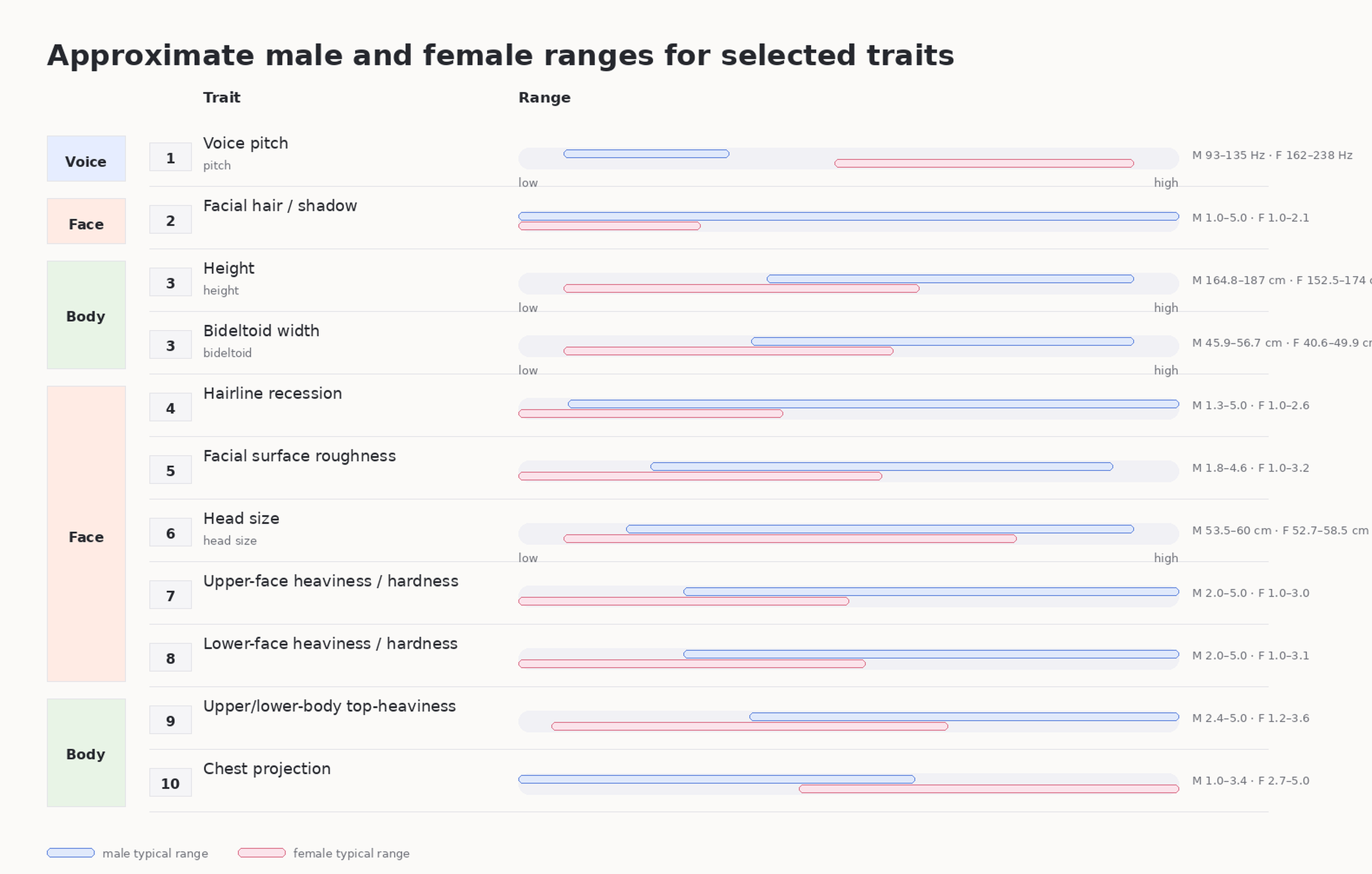
Looking at pitch specifically, there is no overlap in normal ranges between male and female voices (~93–135 Hz for males vs ~162–238 Hz for females). For other factors, it is not as strong, but can still be pretty significant.
There is a reasonable meta-analysis on this topic, which found:
The pitch, or fundamental frequency (F0), is the most robust predictor of perceived gender.
Vocal tract resonances, reflected in the spacing and height of formant frequencies (especially F1–F4), also play a significant role
Formant spacing was also related to the perception of gender
Voice quality, particularly breathiness, has shown mixed influences on the perception of gender
other acoustic features have shown links with the perception of gender in the voice. For instance, dynamic changes in intonation and loudness patterns also contribute to gender perception.
2. Facial hair/shadow (Face)
The lower range of facial hair/shadow is basically androgynous. If one has not facial hair, it can be read as both masculine or feminine, but if one does have facial hair or shadow, it is read as clearly masculine. It’s pretty intuitive to see.
3. Height/Body Scale. (Body)
Body scale differs moderately significantly between males and females.
Height is directly important in some ways, but is part of a larger attribute of “body scale”, such that a tall but narrow person is still in some ways smaller than a slightly less tall but much broader person, which we can somewhat proxy with shoulder width (bideltoid - distance between outer part of both delts).
Considering 5%-95% intervals in the US, we can look at height and bideltoid width:
Height ranges: female 152-174cm, male 165-187cm
Bideltoid ranges: female 41–50 cm, male 46–57 cm
This trait of body scale is not so much a single trait that overrides all, but it acts as an important and visible prior, which alters how much scrutiny is put onto other traits.
4. Hairline recession
This is another trait that is similar to facial hair. For women, the variance is mostly very little. For men, the variance is very high. Having a feminine hairline is mostly just considered androgynous, but having a receding hairline is considered very distinctly masculine. For the most part, nobody really wants hair recession anyway, and it’s pretty preventable for most people.
5. Facial surface roughness
For the most part, at the same age, women tend to have smoother, softer, less rough skin. While men tend to have slightly rougher, less-soft skin.
I don’t really know how to measure this that well, there are some heuristic scales that look at softness, oiliness, pore size, laxity, etc.
This one moderately important for passing, but also more important for looks. if you have extremely soft and smooth skin, this does read as slightly feminine, whereas if you have very rough skin, it does read as moderately masculine.
This is mostly affected by hormones, and is a trait that I feel does start off as not-that-different when young, even in late teens early 20s, but continues to diverge with years of estrogen vs testosterone in the blood. That being said, things like basic skincare (suncream, retinoids) do help a lot here.
6. Head Size
Head size varies a lot between person-to person. The overlap in sizes between men and women is quite high so it’s not overwhelming, but smaller heads read as more feminine, while larger heads tend to read more masculine.
As a proxy, there is head circumference: female 52.7–58.5 cm, versus male 53.5–60.0 cm.
This is something that is slightly correlated with general body size though, and so doesn’t seem to matter that much as an additional factor in practice. It is also not something you can physically change, but it’s perception is affected by hairstyle and other facial components. The next two traits are more overall.
7. Upper-face heaviness/hardness
This is mostly referring to bone-structure features in the upper face. This includes browbone, orbitals, nose bridge, facial width VS cheek fat, “relative eye size”. These factors are more explicitly gendered, but to various degrees.
This is often one of the most important remaining visual aspects people can change to pass better or worse, and getting FFS, especially on browbone + orbitals + nose bridge, can make a significant difference on passing better.
8. Lower-face heaviness/hardness
this cluster i consider to be features such as facial length, chin projection, jaw angularity and width. These are slightly less important than the upper features, but depending on the person can be quite important too. This is generally slightly harder to make larger effects on with FFS, since generally you require more advanced surgeons with additional orthodontic specialty, but the most jarring differences can often be changed.
Additionally, this is one trait that seems to differ a lot ethnically. For example, jawlines of Slavic and Korean women can often be more pronounced than jawlines in other close-by countries, so it’s one that can sometimes be more forgiving, and a minor amount of larger features can sometimes be seen as desirable.
9. hip-waist-chest size
Another aspect that differs greatly is the relative ratio between upper-body/rib-cage, and lower-body/hips. Some most relevant proxy metrics for this are [shoulder-to-hip-ratio] and [underbust-to-hip-ratio]. There is some chance you are in the androgynous zone, in which case it is a pretty good place to be. But there is some reasonable chance you are in a top-heavy or bottom-heavy ratio when you would prefer to be in the other, in which case it becomes more difficult.
The size of these places is driven by aspects like bone underneath, and muscle+fat on top. It is relatively doable to gain/lose fat+muscle, but quite difficult to alter bone.
That being said, this is one that is relatively easy to hide with loose clothing. And for the most part, cis people don’t tend to notice this that closely anyway. So you may personally dislike this aspect of yourself but it probably doesn’t play as large a part in your passing as you think.
Waist indentation also exists here, proxied by [waist-to-hip ratio], but mostly matters for looks rather than for passing.
[Getting reliable metrics for these is a bit annoying and I didn’t have time to get them, I may add them here at a later date]
10. Chest projection
I don’t really like cup-size as a metric, since it doesn’t nicely take into account how different rib-cage sizes can be. But as you know, males tend to fave pretty flat chests (with some larger sizes from trained chest muscles or from gynocomastia), whereas women range from flat to very large. There are additionally differences in shape between male and female chests. I don’t think it’s particularly worth diving into here since it’s mostly obvious.
11. Hand/Foot/Knee etc
Hands and feet can sometimes vary to be smaller [more feminine] or larger [more masculine], but in general these mostly are pretty proportional to body size, and nobody pays much attention to size as much as to general skin texture and such. There are differences in knees that do mean in knee-related surgeries there need to be special accommodations depending on this, but I harp again that nobody cares nor knows how to notice the differences.
In the next days, I will try to give more detailed breakdowns into how much these attributes are modifiable, and some methods for this too.